


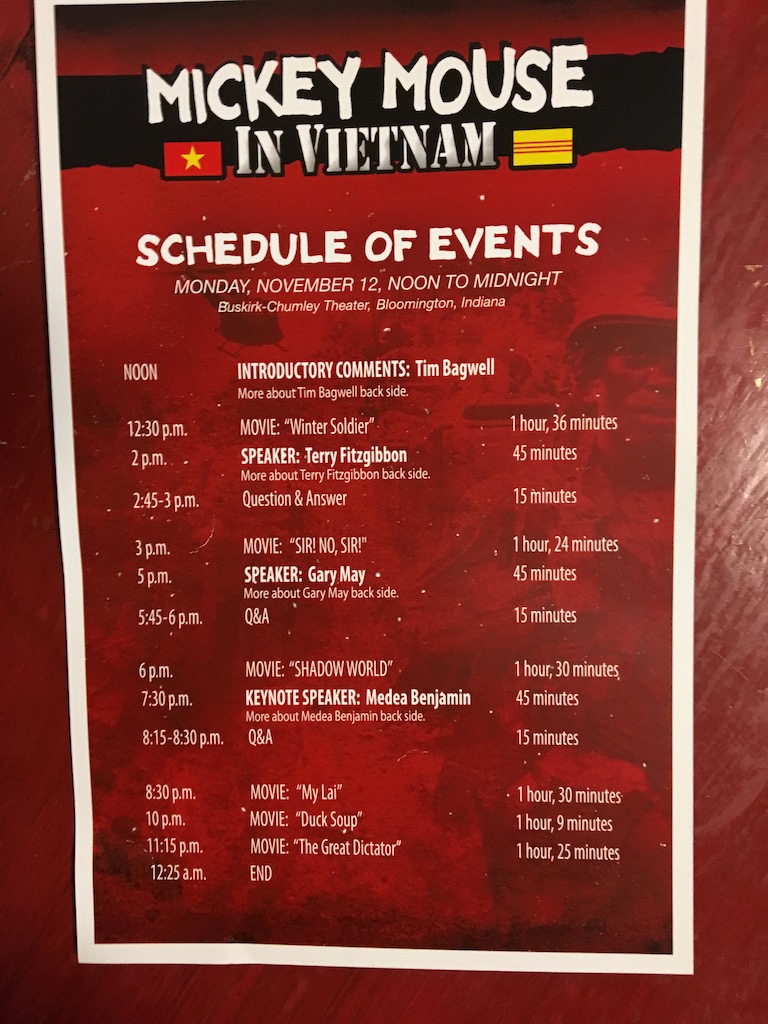
 The contrast could not have been greater. A nearly full house for the Benjamin Britten War Requiem Sunday afternoon vs. the 20 or so folks (including me) who attended the opening session of the 12-hour anti-war film and lecture event on Monday afternoon. Both events to commemorate this year’s Veteran’s Day.
And yes, those 20 people in the second audience were all old folks like me who actually remember the Vietnam War, and the “body counts” every night on T.V., and our anti-war movement inspired by the military draft.
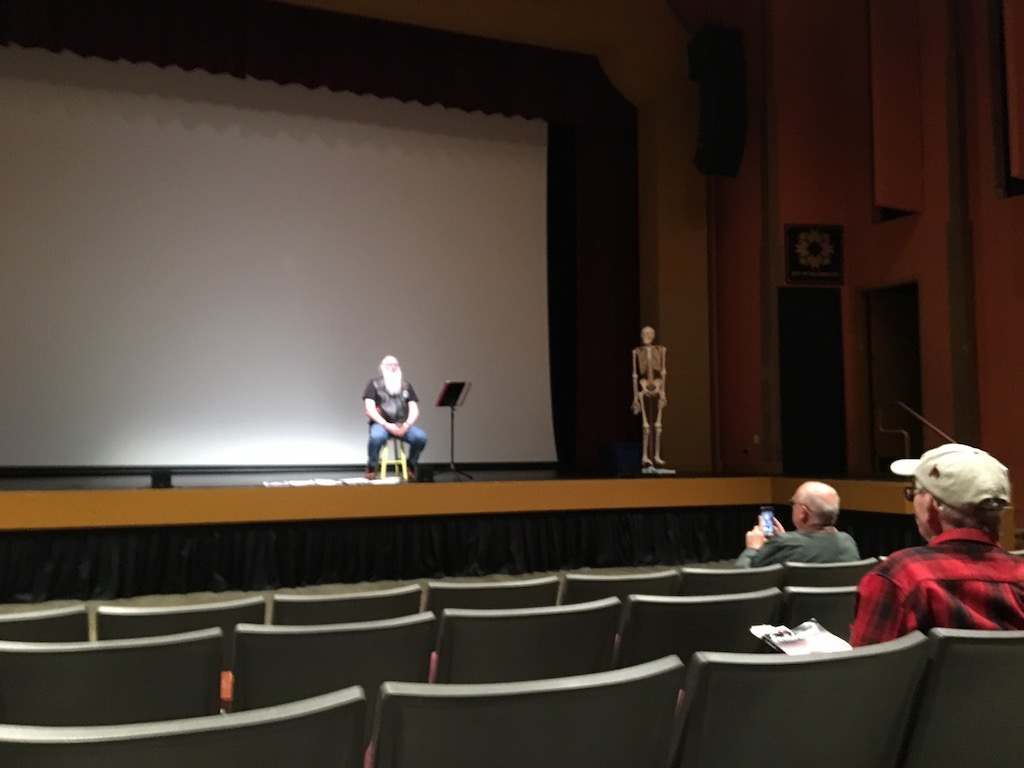
I was, and remain, intensely grateful to Marine Corps combat veteran Tim Bagwell for putting this entire free event on, shelling out his own money, thousands of dollars, as, he says, his gift to Bloomington. Those of us who did attend, by the time five minutes had passed of the first film, Winter Soldier, were squirming in our seats.
Though I knew the Vietnam War was filled with atrocities, I did not realize that this war was shock-full of events made famous by the Mai Lai Massacre.
At the time, this massacre was scapgoated, billed by the MSM as a horrific exception to the rules of engagement of war. NOT! According to the testimony of veterans at this 1972 Winter Garden Investigation panel discussion, it was routine to wipe out villages, raping, torturing, and the killing villagers and burning their “hooches.” Furthermore, their ears were cut off and brought back to camp. Whoever got the most ears earned the most beers. Atrocity was routine.
Cut forward now to the second time I steeled myself to re-enter this event yesterday, at 6 p.m., for a showing of Shadow World (about the Military Industrial Complex), followed by keynote speaker Medea Benjamin, a well-known — and fearless! — international peace activist who co-founded Code Pink.
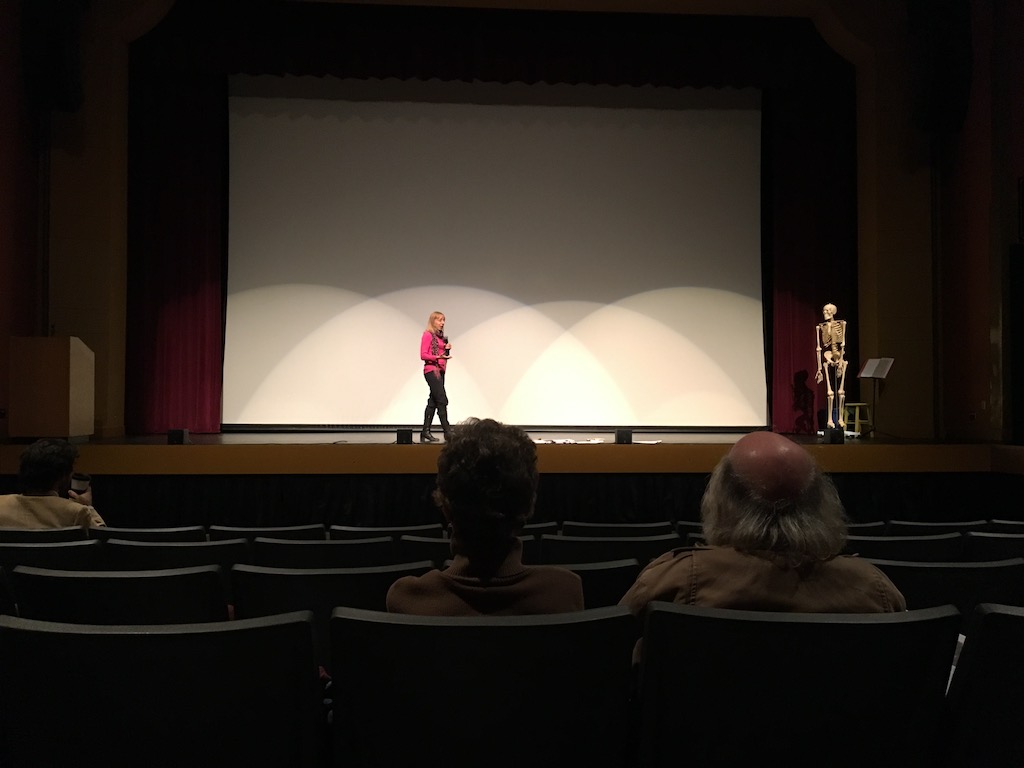
Media told the story of how she became a peace activist: She was in high school, when her friend’s older brother entered the military. He was excited to go, and they were all excited for him, as a patriotic American going to help save Vietnamese people from Communist takeover.. But, as Medea tells the story, letters home from this young man gradually changed. Something was wrong. He no longer seemed to be the same person. Finally, the day came when an envelope arrived in the mail containing a human ear. “Here,” he told his sister proudly, “a gook’s ear. You can wear it as a necklace.”
Medea happened to be there when the letter was opened. The experience was so shocking that she rushed into the bathroom and vomited. “And that’s when I became a peace activist” she concluded, without further comment.
The horror that Medea felt is echoed, of course only second hand, at one remove, in the movie Winter Soldier. After the first five minutes, I kept wanting to leave. My body and mind and spirit just did not want to subject myself to tale after tale of atrocities committed by young American men who, clear-eyed, apologetic, and no doubt still waking up with nightmares, said that, in order to participate in the war, they were trained to descend to the level of animal, just as they saw the Vietnamese themselves as animals, not human, so killing them was no big deal.
As I sat there, squirming, I reflected on the extreme difference between appreciating the intense horror of war refracted into “art” — for example, the Benjamin Britten concert — and the visceral horror of war close up and personal — even though still at one remove. This was an old film about U.S. atrocities in Vietnam. Where are the same films about U.S. atrocities in the Middle East, Afghanistan, Ukraine, and who knows where else on and round our 800 overseas military bases during the decades that followed and still ongoing?
And I think about the veterans assembled there, in 1972; still very young men. Who are they now, and where are they? Homeless and alcoholic? Opioid addicted? Or are they just dead of broken hearts.
Once again, hats off to Tim Bagwell, who spells out his own PTSD for which, he says, both diagnosis and treatment were first received in Bloomington. Thus his gift, back to his adopted community.
In the morning session, during Q & A, I raised my hand and told about the three years, back in the early ’80s, when I committed to being a tax resister, writing a letter each year to the IRS to say why I was not going to pay taxes.
Since I was living largely below money anyway, my resistance was not a big deal, unless I began to enter the culture and the lifestream of money more fully.
I will never forget a walk I took with myself one spring day, the walk when I decided to NOT be a tax resister, but to pay my taxes, even though I knew full well that this would mean at least 50% of my hard-earned money would go to the military. I made this choice because I realized that to continue as a tax resister would mean either not ever entering the culture, or jail. Those were my choices. Were these choices authentically part of my own life path?
As I made the decision to stop resisting, I was highly aware of the contradiction this set up within myself. And ever since then, this contradiction has been the foundation for empathy with others (all of us, or most of us) who find ourselves, even though we might be well aware of the consequences of our choices, participating in the ignominy of the American Military Industrial Complex, which is threaded through literally every aspect of our society.
How many of us would it take, I asked the 20 people present — rhetorically? — to begin a massive tax resistance movement? 30%?
By the time Medea Benjamin took the stage, a woman who has given her life to stopping the war machine, there were I guess 80 people in the audience, all but one of my generation. Slightly better than the morning, but nowhere near the 3000 present at the enormous musical event the afternoon before.
As Tim Bagwell put it, up on the stage, it’s just too difficult for people to contemplate the fact that the U.S. is in the business of murdering people world-wide, and pretending otherwise, or covering it with bullshit about “making the world safe for democracy.”
My own anti-war actions are mostly confined to sharing what I find about the MIC here on this bog. And to speaking up in public, and with my friends and family. At this point in my long life, however, I would be willing to go to jail, if necessary, in order to help begin a tax resistance movement.
 DONATE
Leave a Comment