


 Note: The Siberia/Mongolia articles will all be archived on this page.
Check this out. First, a photo taken from the air, where I happened, uncharacteristically, to be sitting in a window seat on way back to Ulan Bator from Siberia.
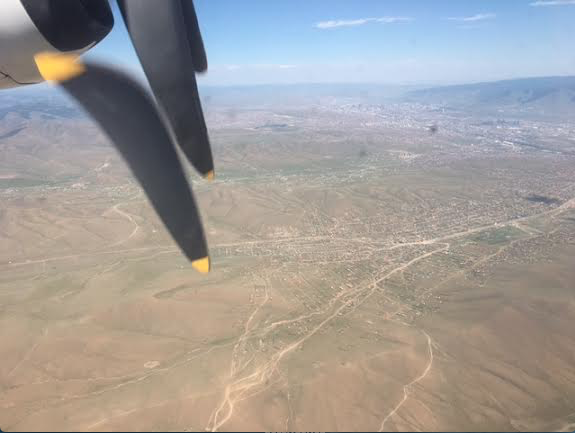
Can’t tell what it is — until you ZOOM IN! All those tiny white dots are yurts. I captured this scene on my phone, and the zoom on camera shows them clearly. Not so here. Please take my word for it.
60% of the suburbs of Ulan Bator (1.5 million people, one-third of the entire population of Mongolia) are yurts, which are, traditionally, dwelling places for nomadic Mongolians. I lived for nearly two decades in a stable, established “Kelly Yurt Park” in the Tetons of Wyoming, and it looks like the yurt suburbs of Ulan Bator are also somewhat stable.

My yurt in winter.

I loved yurt life. So far, my very favorite way of life on earth.
Life in the round feels very different. You don’t bounce off the walls, though you do tend to psychically spin! Indeed, to not do so you must remain centered! Moreover, you sense nature all around you, having only a thin skin separating you from what lies beyond. The rain drums down on the roof, the wind howls — and, in Wyoming, deer, moose, bison and bears live nearby; a yearling moose once spent an entire winter next to my yurt, and snored! — none of nature’s drama is avoidable in a yurt. Full Moons light up the interior. Starlit nights are visible through the plexiglass dome from the bed below. Aaaaah. Yurt life!
And BTW: I’ve heard that yurts are the most thermally efficient structure in the world. I usually burned only 1.5 cords of soft wood a year, and in winter it could get down to -40°F (though that was rare).
As far as preferences go, for me, Green Acres Village in Bloomington comes in a close second, and holds promise of even surpassing yurt life in Wyoming, due to the growing closeness of our village life.
Growing up in a large family (first of eight children) I have long been aware of the need for continuous rebalancing of the twin forces of individualism and group life. In Wyoming, I had my own yurt (after a few years joined by my new husband Jeff), and yet our group life was, on the whole, full of drama and conflict. For me, despite my love of yurts, that life would not have been worth it, except that a few dear friends lived in the yurt park as well. Our conflicts usually had to do with the seeming dichotomy between individualism and community. This “contradiction,” this need, ultimately, for all of us, to be able to hold two opposite ideas and values in our minds and hearts at once, recognizing their mutual relationship and interdependency . . . It’s never just one or the other. Never just me or them. Never just service to self vs. service to others. Rather it’s always both. Let us hold both ends of any spectrum in mind and heart when we make any decision. In doing so, we learn to see through the 3D illusion which holds us in thrall to having to choose one pole of any duality, for this is the fundamental dynamic that drives the world to war.
In America, we’re all for “freedom,” by which we mean rampant individualism, and give lip service to community. Especially since World War II, when G.I.s returned from the war front, to uproot themselves from extended family networks and strike out for college and new homes on the G.I. Bill. These veterans (probably with PTSD; who knew back then?) set up their own, somewhat isolated, due to all the new, modern “conveniences,” nuclear families, which, sooner or later, would and did explode — as their children began to burst the tight confines of 1950s values.
Meanwhile, life in the U.S. has continued to become more and more expensive, with huge monetary outlays required to “keep up with the Joneses” — what most people still seem to want to do, even though fewer and fewer are able to do it. The “tiny house” movement seems to be a step in a different, more simple direction, as does the new nomadic movement in this country that has a few people — not just retirees! — deciding to go permanently on the road in their mobile tiny homes. Co-housing, neighborhood sharing and solidarity, and other forms of “intentional community” are also valuable in rebalancing the polarity between individual and community.
All this is reminiscent of Mongolia. And yet not. Not really. Not much. There, the simplicity of yurt life still holds sway, even in the city of Ulan Bator, as do traditional values that hold the extended family clan together in supportive community.
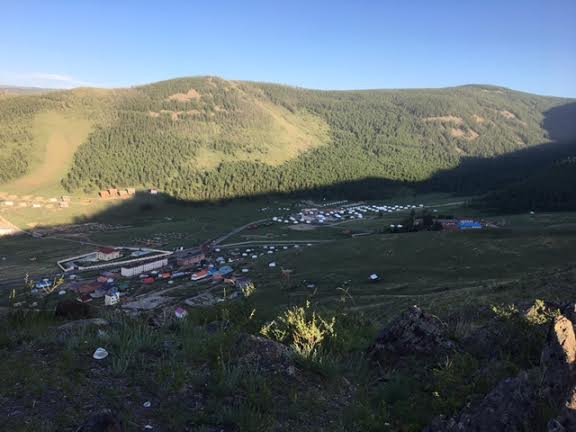
For the most part, that is. On our final afternoon in Ulan Bator, I climbed the hill in back of our new hotel, in a part of the city that is full of new development (I heard later that it’s only been in the past five years), to discover a yurt community just on the other side of the frantic dust and debris of new construction. One wonders what this same valley looked and felt like ten years ago. One wonders how the yurt dwellers feel about the multi-story corporate infrastructure pressing their fragile edges.
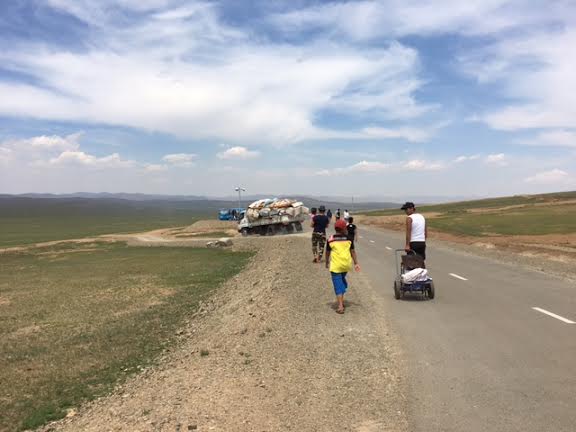
In Mongolia, unlike life in Wyoming’s seeemingly settled yurt park, for the most part, yurts truly are nomadic. Here’s a truck that I happened to capture on camera, carrying a bunch of rolled up yurts.
This scene is from our final day in Ulan Bator, when we happened to be on hand for their national festival, an occasion that lasts one full week, and includes horse races. Not the horse races we are used to. No. These are Mongolian ponies (about the size of Arabians, they resemble mustangs), ridden by boys and girls five to ten years old who had learned to ride — and run, and race, pell mell — as soon as they learned how to walk .
In fact, Mongolia is the only country in the world that has the horse on its currency!
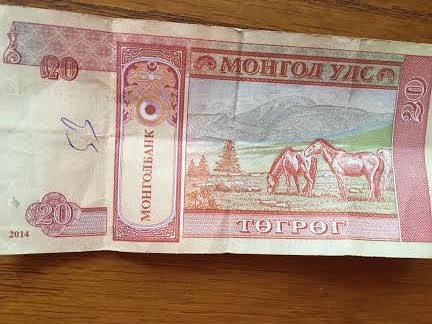
That day we were told the race was 30 miles long, but later heard that it was “only” 18 miles long. Whichever! Either one seems unreal to us in America who have pampered children that we try to keep corralled and monitored, whatever the cost to their innate need to find their own way.
Our little group was present for the finale of that morning’s national competition (all riders winners of local and regional races), about 125 kids on two-year old colts. (The three-year-old race would be that afternoon, and the finale, a race with stallions on Sunday — all with small children on top, and the smallest, lightest favored to win.)
Here’s the setting, ca 20 miles (?) from Ulan Bator, grazing horses in foreground, and temporary yurt village in the background, set up to serve those present with the traditional meal on race day, a large fried bread pocket filled with chopped meat.
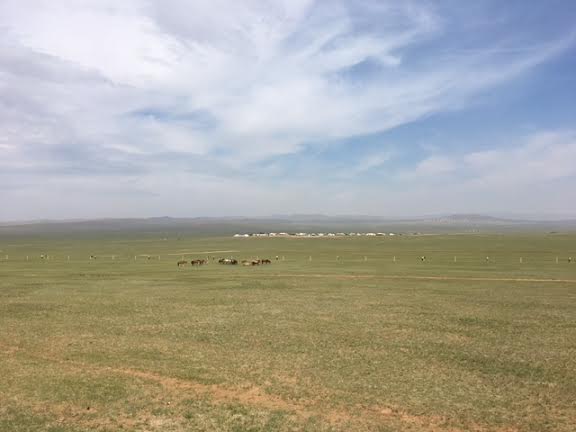
We were in the stands, looking to the west, and soon could barely make out a north-to-south dust cloud . . .
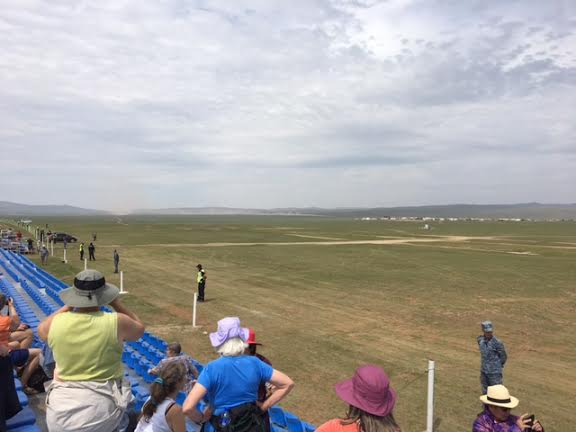
Ah, here they come, the lead horse clearly outdistancing all the others, and without apparent effort.
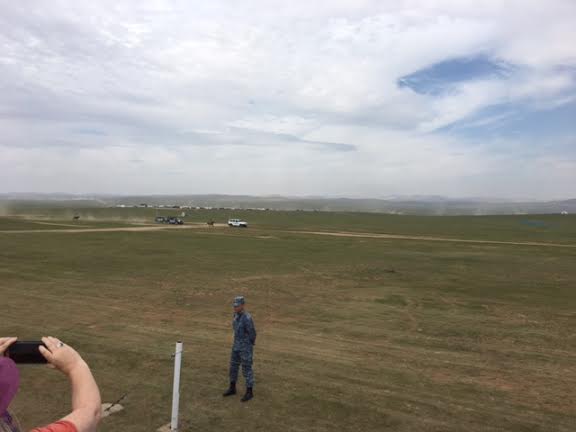
Leaving the truck behind, he sprints to the finish!
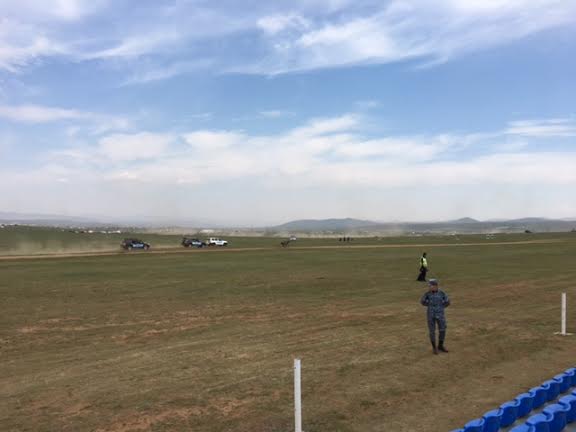
The others surge by in little clumps, clearly more labored, with their riders yelling and whooping, legs chomping their sides, reins slapping back and forth . . . We whooped and eheered for them all.

Out of approximately 125, four or five horses are riderless, racing along with the rest. Both the three first three riders and the final one receive prizes. The first because of their speed, the last because it was probably the weight of the rider that made him or her fall back.
I presume the kids who fell off are okay? No doubt exhausted. Here’s one of them sitting behind one of his support people afterwards. That palomino sure looks sweaty and tuckered out.
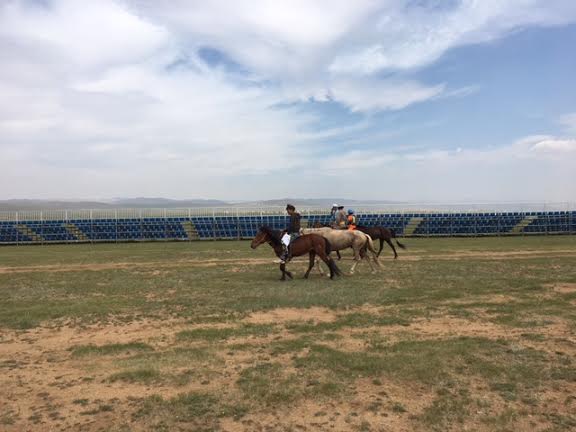
The riders all have mandatory blue helmets, but don’t all wear them. Fox News put out a story in 2012 that called Mongolia to task for their kids’ races. Who knows how much of that story is fear mongering. We Americans are so very unused to kids dealing with risk and danger on their own. What else does this kind of training give these young Mongolian riders? Can you imagine young American children off their screens and into their bodies, at one with their animals, focused, skilled, relentless, going the distance?
A few horses with older riders cluster together afterwards. They are watching a young person trying to ride a mechanical bull.
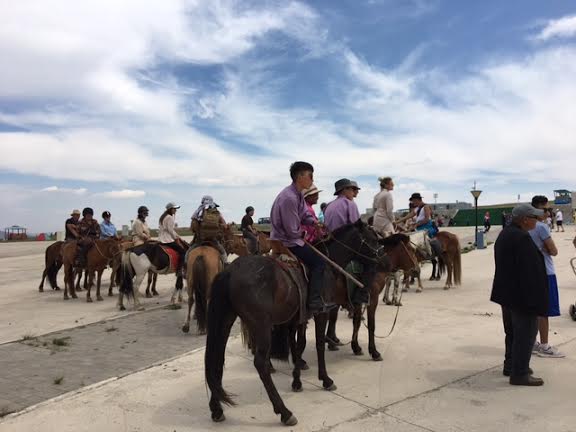
Of course I would love to idolize the Mongolian way of life. And yet, the modern world does co-exist there. Cell phones are not rare (just like most peasants on donkeys have them on the island of Crete), but given the vast distances between human settlements in Mongolia, we can see why. And I never did see a native, still-nomadic Mongolian seemingly addicted to his screen. Perhaps they don’t have the internet on their phones? Even so, will their cell phones automatically begin to atrophy their native communion with each other and nature, including, I presume, telepathy?
 Here’s a contemporary iconic scene. Taken on Lake Baikal, at a restaurant stop in Siberia. Although there are some yurts for show in that country, most of the ones people actually live in do seem to be in Mongolia. This yurt by the cell phone tower happens to be a commercial yurt, selling tourist stuff. Yes, the market exists there, too. And it shows in various ways.
For example, on the outskirts of Ulan Ude in Siberia, we passed by a gleaming new sports stadium, which, our guide Erjan — who was born in Russia and has Russian citizenship, but is pure Buryiat (the name for indigenous Mongolians who crossed north into Siberia) — told us, her voice wistful and sad, is located on the very ground where her childhood home used to be.
Meanwhile, on that same final day when we witnessed the end of the national two-year old colt race in the morning, we went downtown to the central plaza in Ulan Bator in the afternoon for the ceremonious parade featuring Mongolians in their native finery. I was particularly lucky to be well-positioned to check out the lines of people coming by, all proud to be Mongolian, little kids, teenagers, parents, grandmothers, aunts, uncles, on and on, all those extended families connecting in this way too. Notice the predominance of silk — huge difference from rough-hewn Native American finery here. Remember, Mongolia sits next to China.
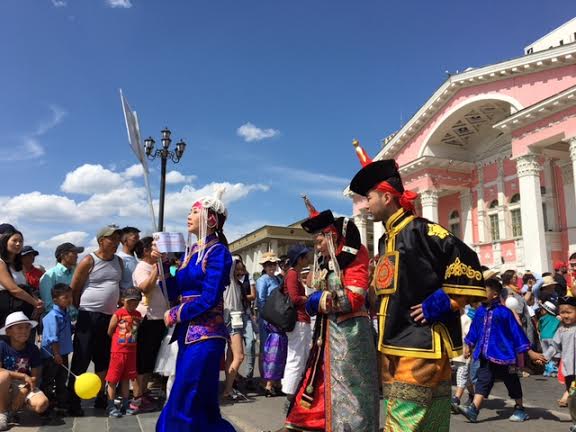
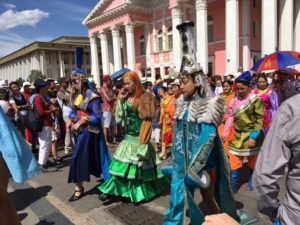
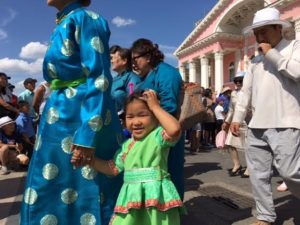

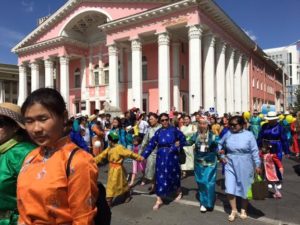
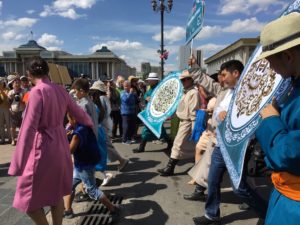
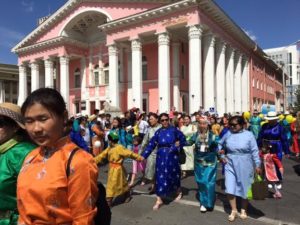
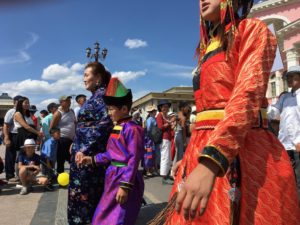
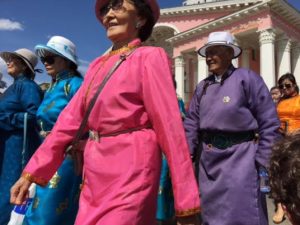
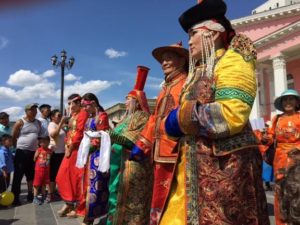
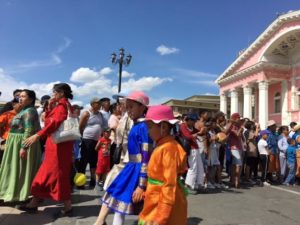
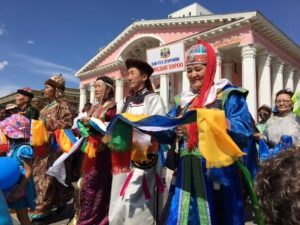
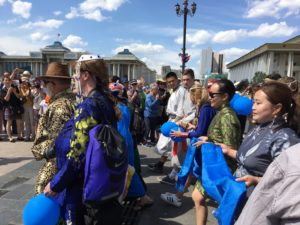
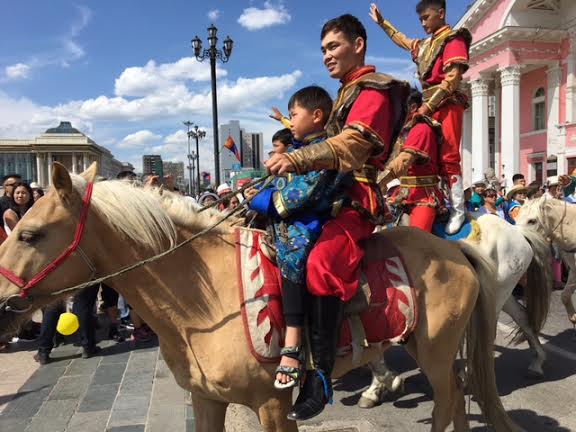
I cannot help but contrast their beautiful parade that demonstrates such national unity with our “patriotic” 4th of July parades, which usually feature, besides the sometimes wonderful panoply of a vibrant community, the rumbling machismo of heavy military machinery.
On the other hand, even as I experienced the euphoria of tribal unity in Mongolia, I was gifted with a deeper compassion for us Americans. For all this time — ever since we decimated and otherwise corralled and denigrated our own indigenous peoples, and have been bearing the burden of hidden guilt and shame for that ever since — we’ve been attempting to learn to not just tolerate but truly integrate and appreciate all the various cultures, traditions, religions, and races of the entire world on one continent.
No wonder it’s hard! No wonder we’re so fractious! At least the Mongolians have their ancestral traditions to guide them; plus they are still connected to both each other and their land. We disconnected bobble heads have only our intuition to guide us as to what we might do if we were all striving to evolve the very best that our hidden souls have to offer us.
 DONATE
Leave a Comment